
More Work Caricatures
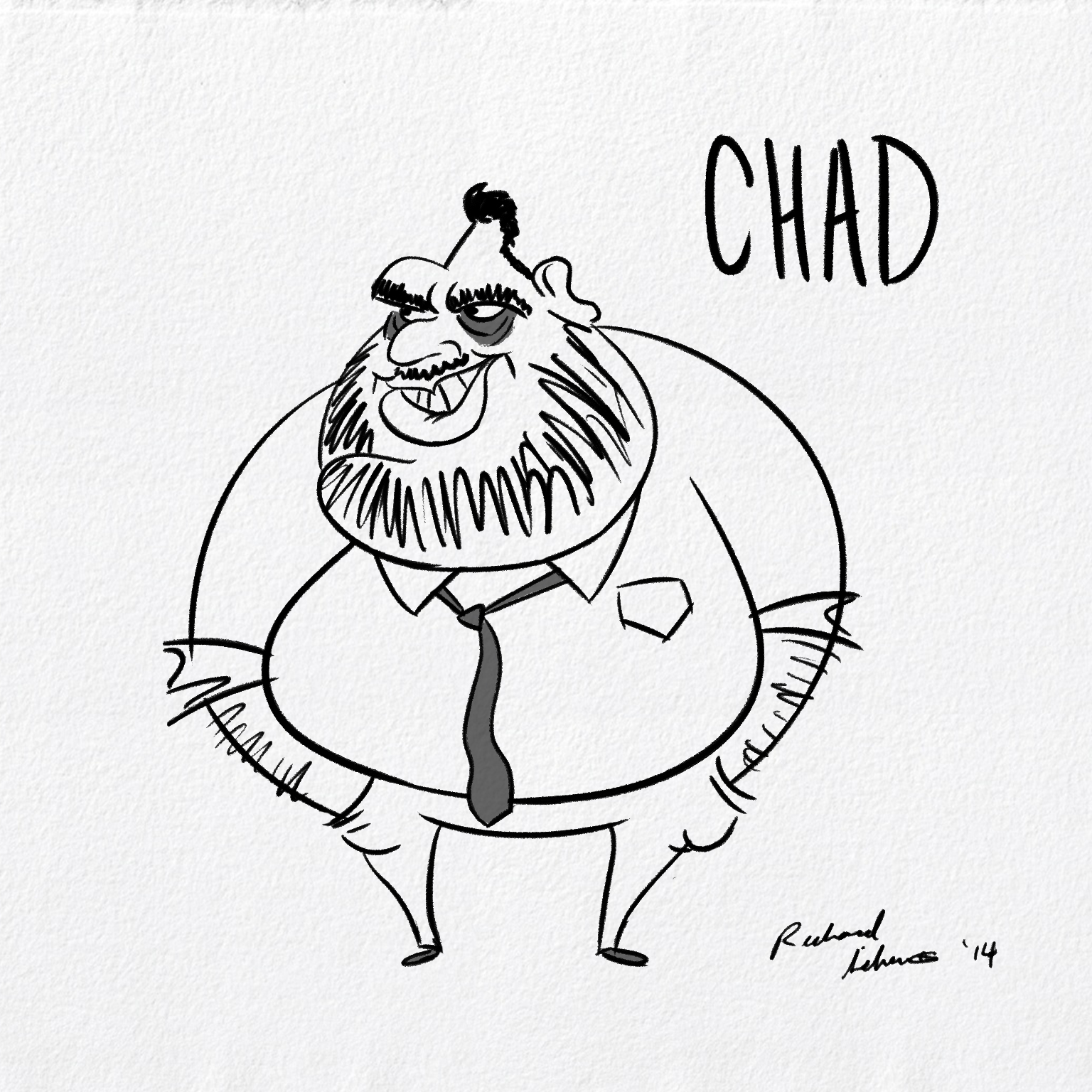
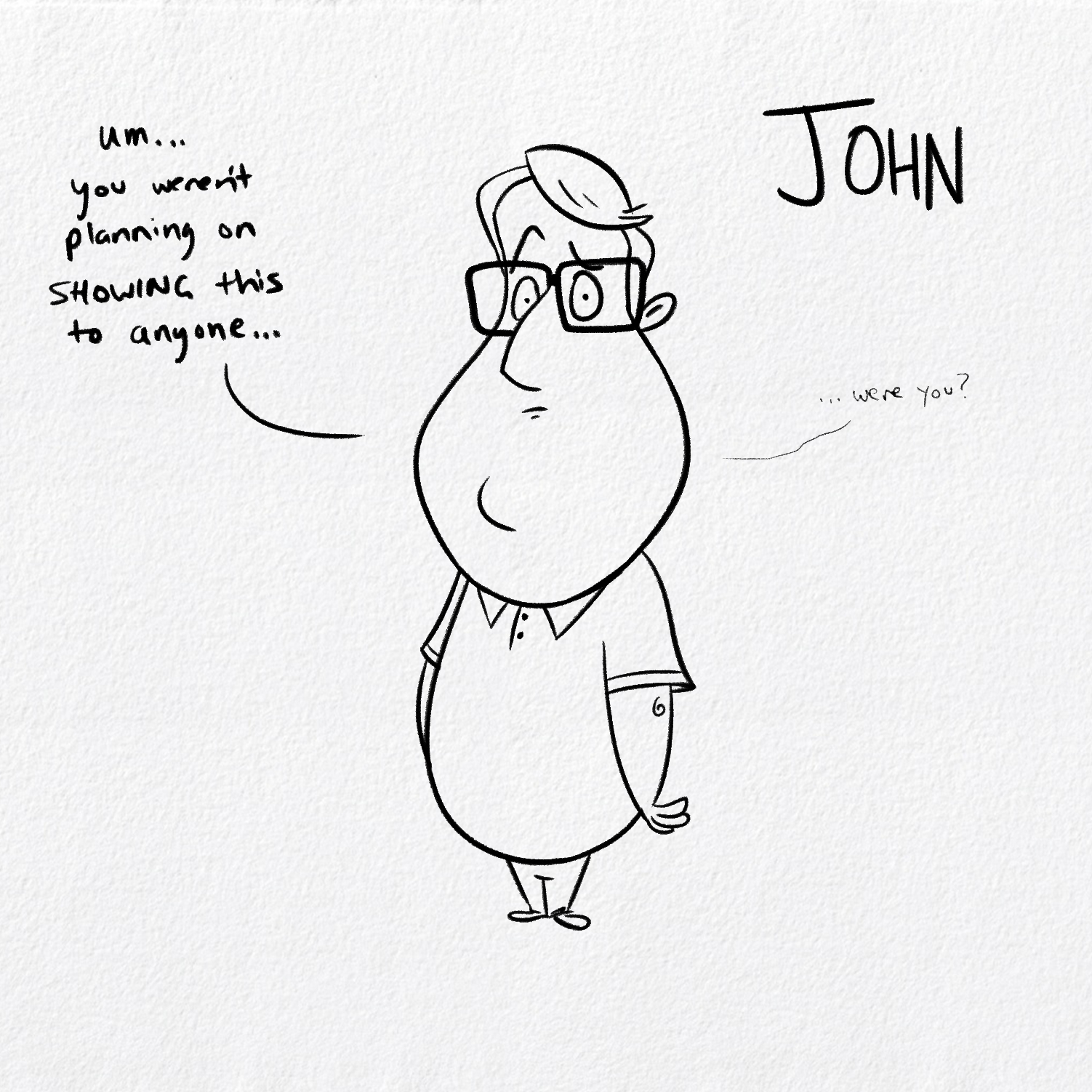
Winners of the weekly drawing contest at my job win a caricature. Meet Chad and John — tied in the previous contest.
Freddie Mercury!
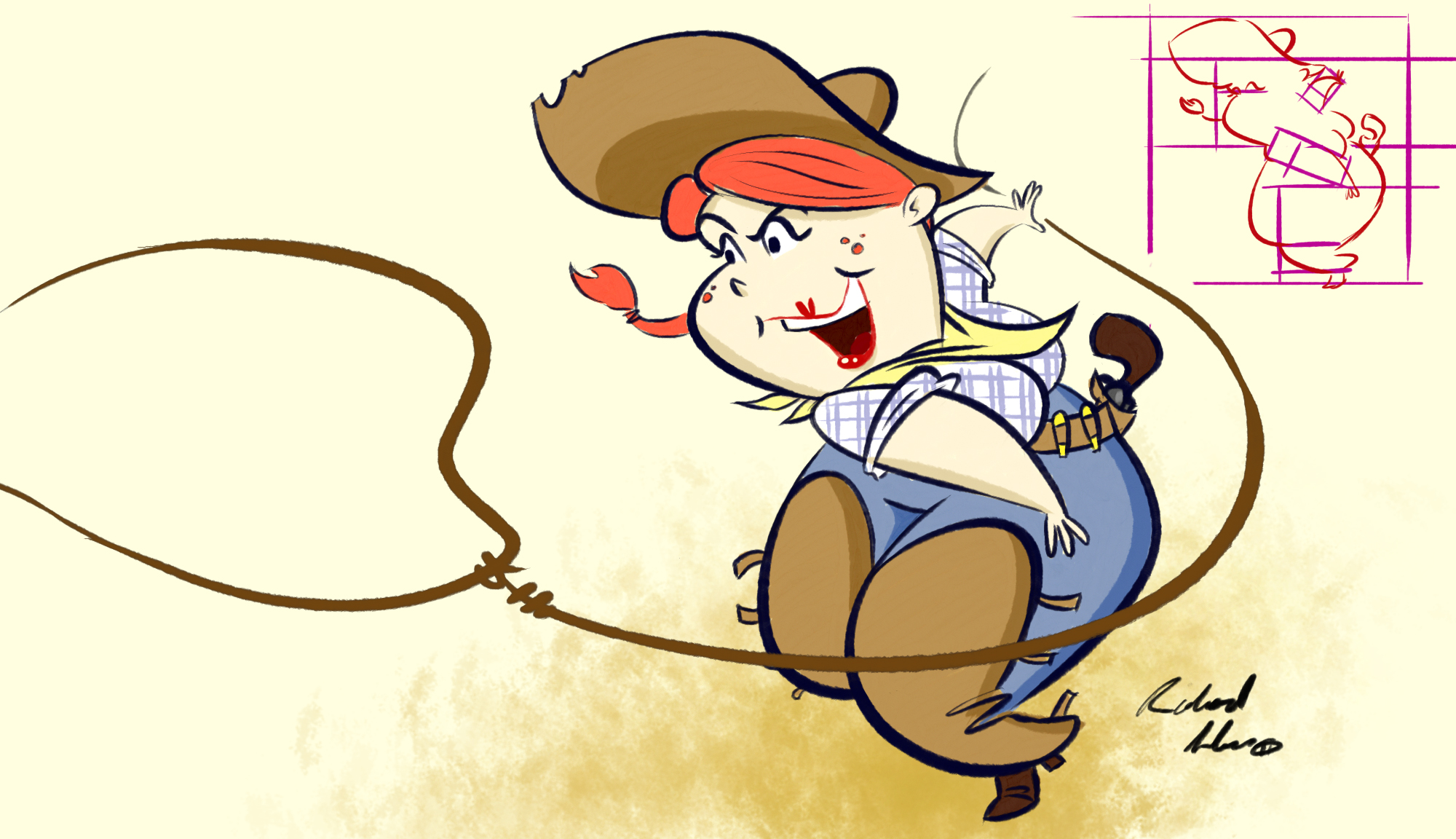
Here’s a caricature design I did for my Schoolism class. This time I thought I’d throw some of my references and ruffs up here because sometimes it’s interesting to see the process, and I really liked how the pose turned out.


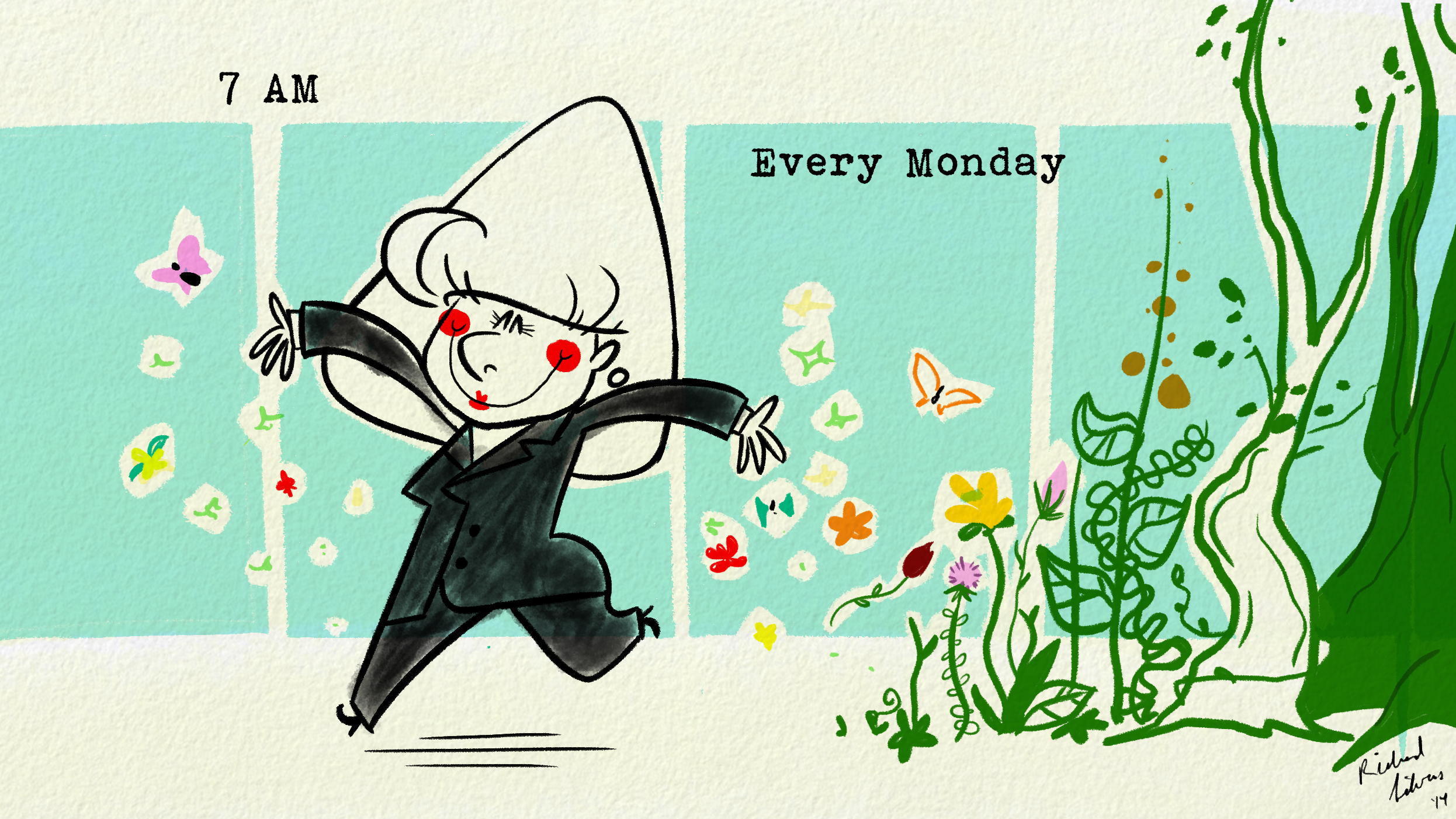
Drawing.. Bruce Timm Style
I’m taking an online character design course, and our job this week was to create an incidental character in the style of a particular artist and/or show.
I went with something pretty far outside my more cartoony comfort zone — a Bruce Timm style action show. It was fun.

Character Design II with Stephen Silver
It’s been over a year since graduating from SCAD. So, I decided to indulge in an online course at Schoolism to help me push my skills and motivate me in my personal work.
So — here’s my first assignment from Character Design II! I’m looking forward to getting great critiques from Stephen Silver.
The weird diagram on the right shows how I utilized the Golden Ratio throughout the design.
Crow’s Nest is Finally Online!
It’s been over a year since this short was completed. At first, I had every intention of submitting it to all sorts of festivals. But, time went on, I never got around to it, and now I am capable of such better work that I don’t really want this being seen at any festivals.
Still, it’s the first proper film I ever made on my own, and one of my first films period. I’d be lying if I said I wasn’t proud of the way it turned out.
I’m happy to finally be showing it online to many more eyeballs than would have seen it if it were floating around the festival circuit.
Enjoy Crow’s Nest!
Crows Nest from Richard Silvius on Vimeo.
My Boring-Ass Blog Stats for 2013
WordPress whipped up this nice little summary of my blog activity for the year. So if you are suffering from acute boredom, you may enjoy this. I thought it was interesting though. Thanks WordPress!

Here’s an excerpt:
A New York City subway train holds 1,200 people. This blog was viewed about 4,200 times in 2013. If it were a NYC subway train, it would take about 4 trips to carry that many people.
My Trip to the Amazon, Part III: Disappearing World
My thanks to those of you who have been following my Amazon posts. I know the last one was a little wordy for some. I just wanted to condense everything I knew about Ecuador, the Yasuní, and oil drilling into one, clear post so that everyone could understand the stakes. I think that’s easier said than done.
For Part III, I had written a 2,000+ word blog post about my time in the Amazon rainforest, but I’m going to take the advice of a trusted reader on this one and skip the words in favor of this series of images.
Taken during my four day stay in the Amazon, these photos are of a world I witnessed hovering somewhere between untamed wilderness and “civilization”. Over the next 20 years, the forest you see in these images will almost certainly have disappeared.

The sacred waterfall was a refuge where Waorani women could hide during intertribal wars.

My companions continue past a massive Strangler Fig Tree

Strangler Fig or Kapok Tree? I’ll be honest, I don’t know which.

Domingo had just cleared some trees from a lookout point. I had followed just because.

A Waorani Family in Nenki Pare

Waorani Children in Nenki Pare

Domingo with Blowgun and Spear

I’m a fairly good shot with the Zarapatana — (provided a stationary target, anyway).

Trying my hand at the Waorani technique for making a fire. I’m not very good.
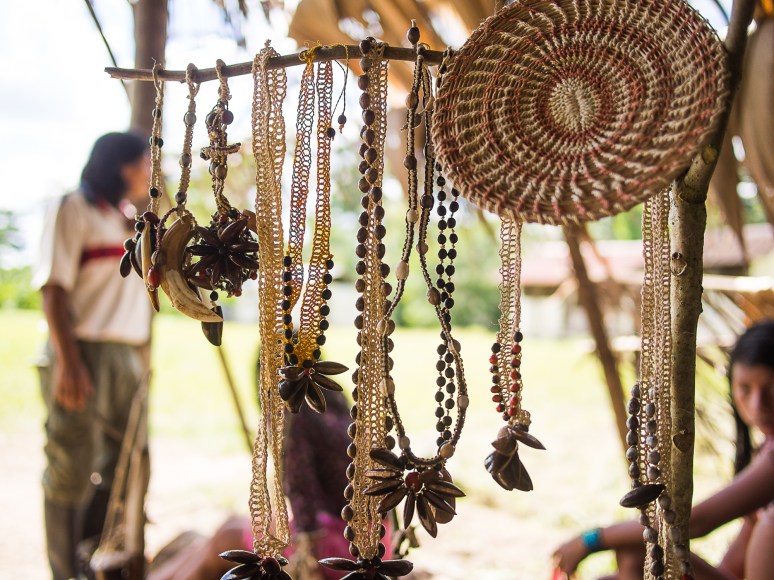
Waorani handicrafts in Quehuere Ono.

Domingo makes repairs to the public lodge in Quehuere Ono.

After collecting materials during one of our hikes, Domingo demonstrates some Waorani crafting techniques.
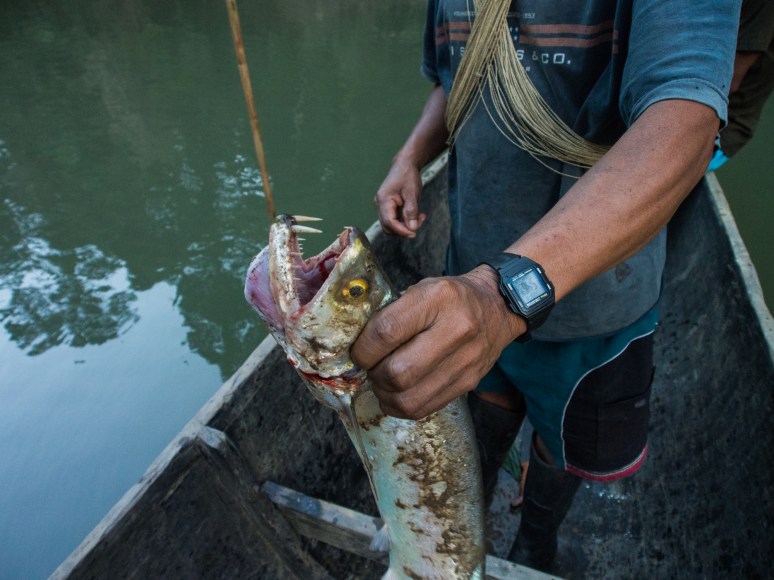
Though our naturalist guide could not identify this fish, the Waorani had their own word for it. After this shot was taken it was violently thrashing about in the bottom of the canoe until Domingo calmly killed it with a blow to the head.

Schools like this are built by the oil companies in exchange for passage into Waorani land.
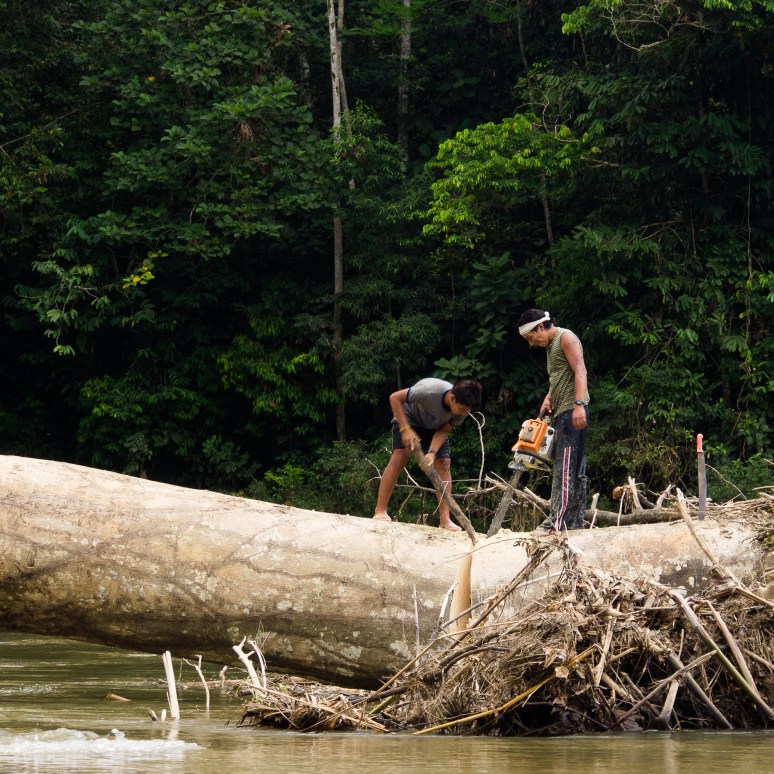
Waorani clear a large strangler fig from the Shiripuno River where it had fallen during a recent storm.
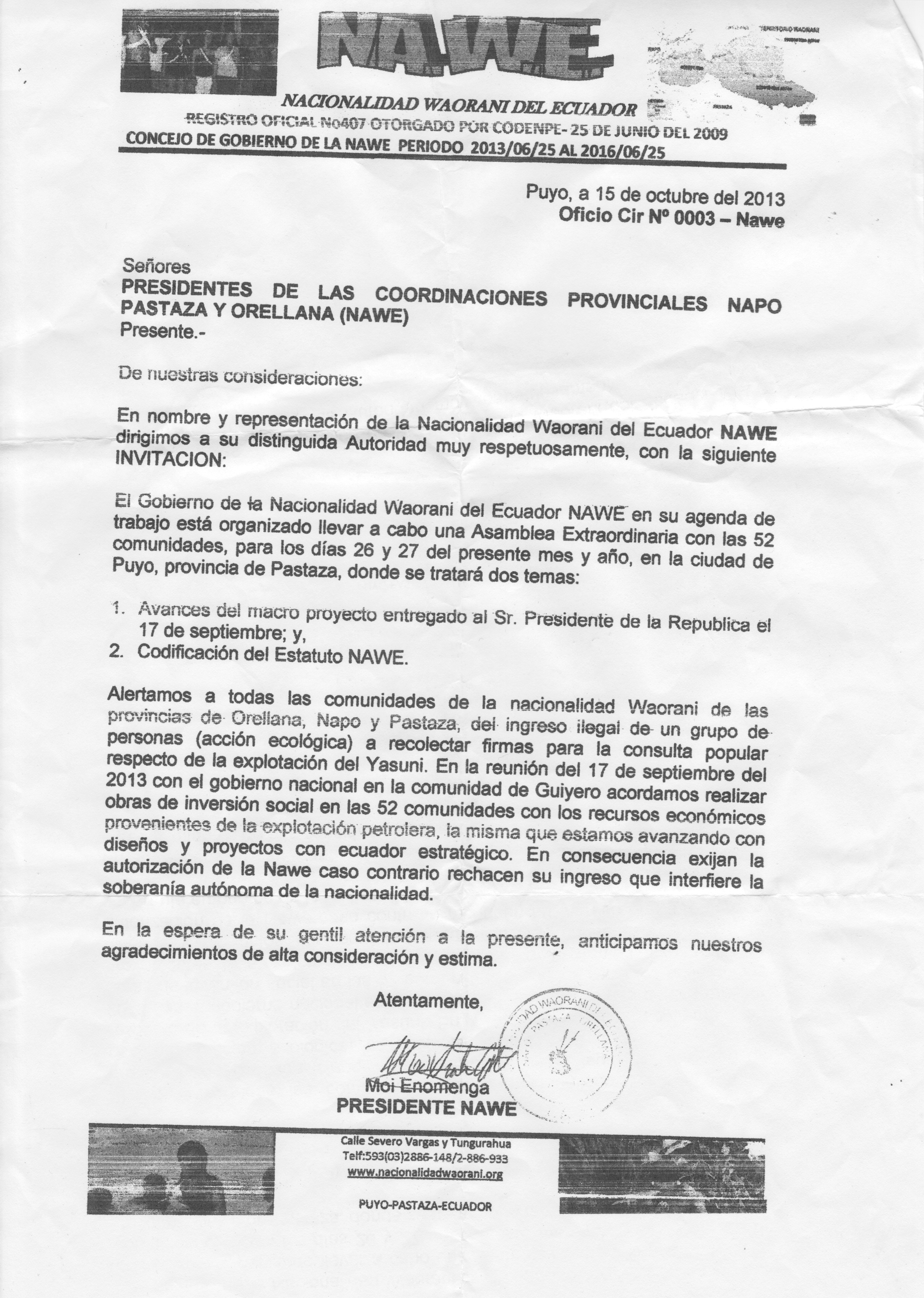
Moi Enomenga, a lifelong opponent of oil drilling, is now supporting extraction. In this memo he alerts the Waorani about “illegal” activists collecting signatures for a national referendum on the Yasuní drilling scheduled for February 2014.
Thanks for looking! I’d consider it a personal favor if you’d share this post to help me inform people about the threats facing the Amazon and its indigenous people!
If I’ve piqued your interest and you would like to learn more about the Yasuní, the Waorani, or oil drilling in Ecuador, Joe Kane’s book “Savages” is great place to start. It’s a quick, riveting read and will give you a far better understanding of the subject than I can do.
In my next post I will show you what happens when we allow oil drilling in the Amazon.
My Trip to the Amazon, Part II: Background
(If you haven’t yet read Part I of my Amazon series, you can check it out here.)
In the summer of 2013, there were several different veins of news about oil drilling in Ecuador.
The first articles I had read, about Ecuador’s 11th Oil Round, were mixed with news about an ongoing lawsuit against Chevron, and news of President Raphael Correa’s unorthodox proposal to spare part of Ecuador’s Amazon from drilling.
I was confused at first, so I’ll try to sum up the three main things that were going on:
Oil Rounds
Oil Rounds are international auctions, in which the world’s oil companies pay Ecuador to gain access to tracts of land called “oil blocks”. Ecuador does this because it lacks the resources to develop the oil fields on its own. The problem is — the majority of these oil blocks are located in the Amazon Rainforest.
This article about Ecuador’s 11th Oil Round was my introduction to the subject. Before that I was, like most Americans, unaware that oil drilling was, or had ever, gone on in Ecuador. Nor did I know that Ecuador was home to a large portion of the Amazon Rainforest — including one of the most biodiverse areas in the world. To give you an idea of the geography, here’s a map of Ecuador:
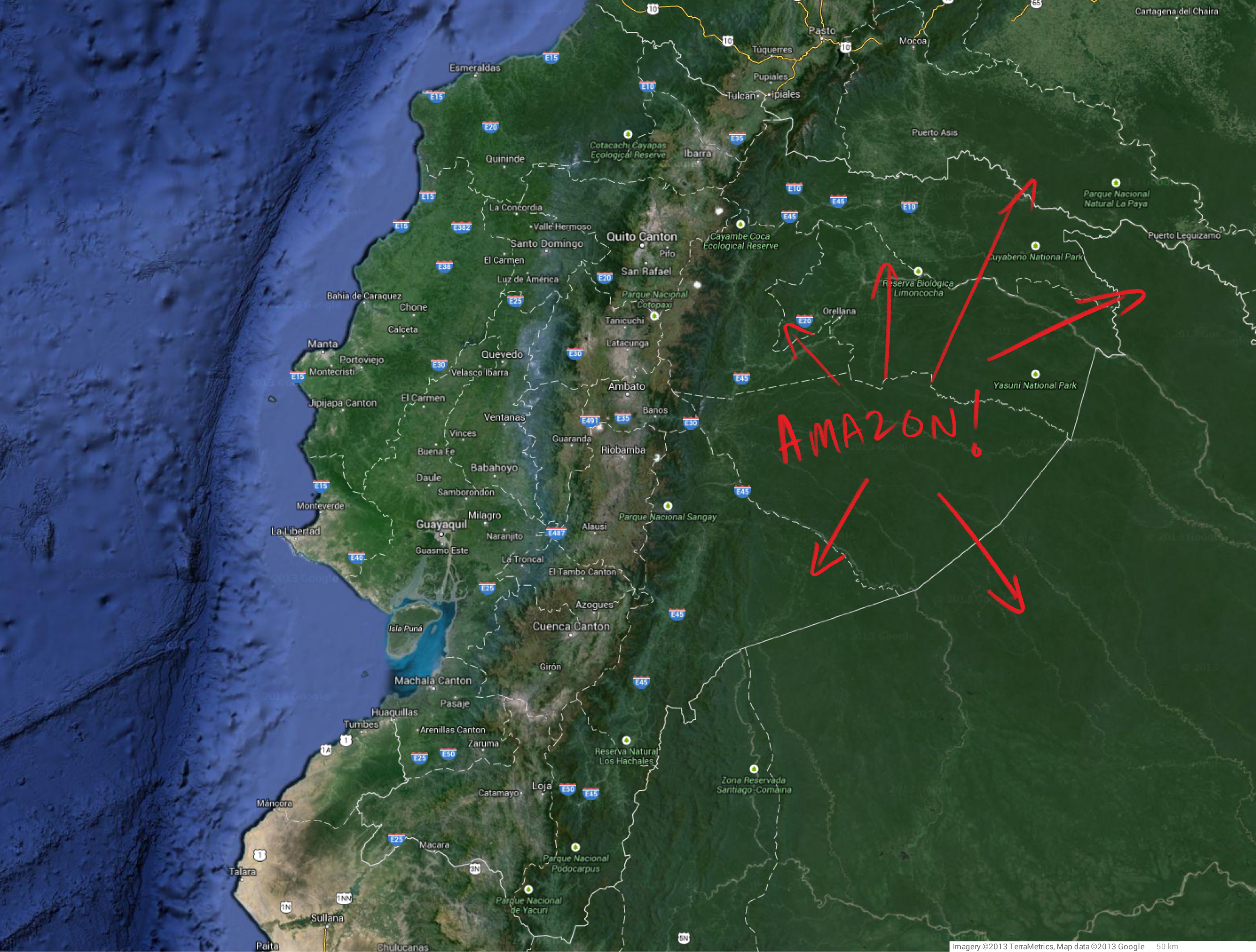
See the really pretty deep, dark green right where I wrote the word “Amazon”? Now take a closer look at the Amazon region — the entire area is partitioned into oil blocks:
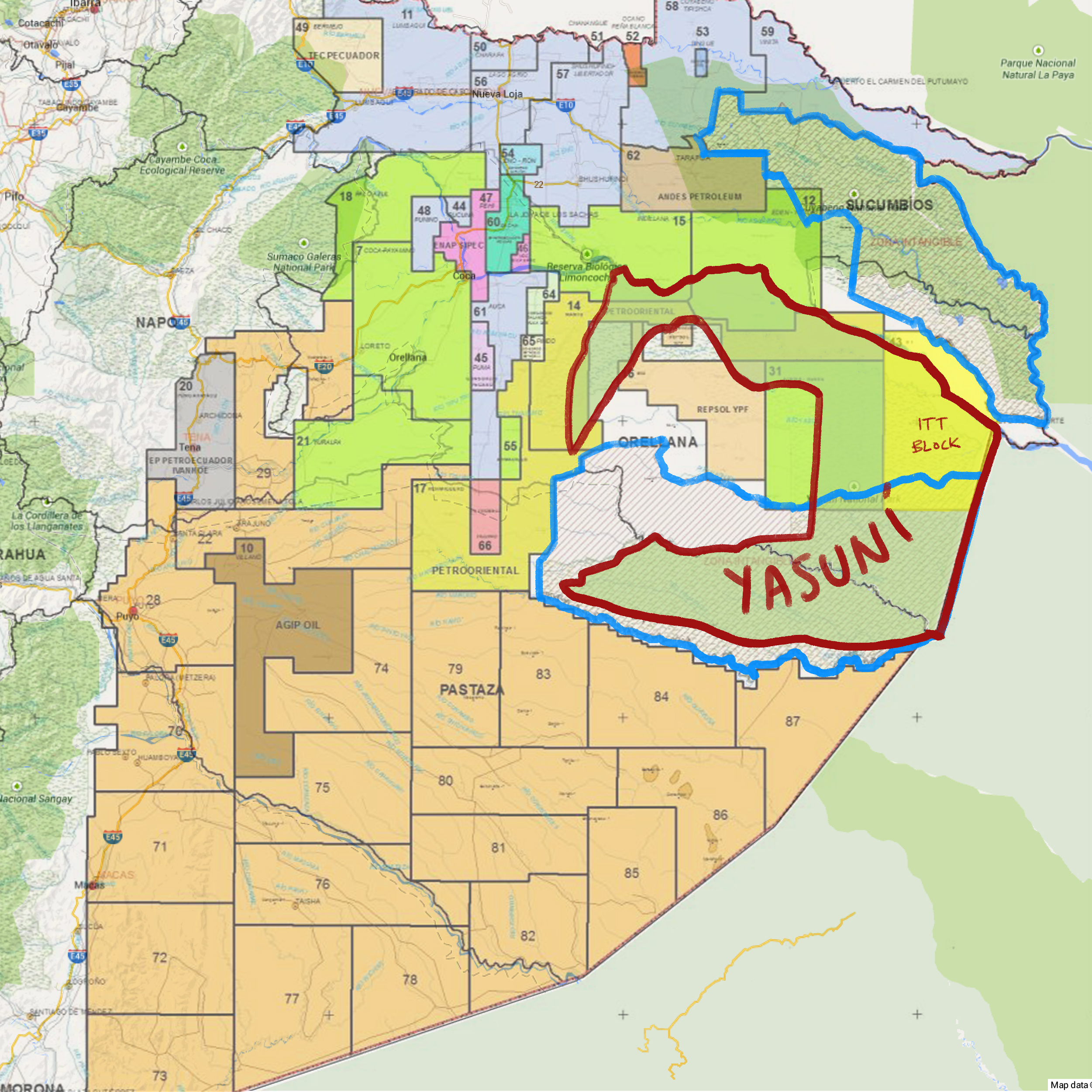
Those light orange blocks covering the area labeled Pastaza span over 8 million acres of primary rainforest. (Primary meaning mature — as in — really old trees and long established ecosystems yet to be disrupted by man). The blocks in the Pastaza were the ones up for auction earlier this year. Bidding on these came to an end on Thanksgiving Day, 2013. The Ecuadorian government has said it will take 6 months to review the bids.
The oil round is widely considered a failure because only a handful of these blocks were bid on. That is extremely encouraging news! We’ll know a lot more when Ecuador announces the results of the auction.
This image shows how intact this part of the rainforest is. Now look North — to the area around Nueva Loja (Lago Agrio). See the difference? Not long ago that area was just as pristine.

The area outlined in red is the Yasuní National Park. As a UNESCO World Biosphere Reserve and national park, it is supposed to be protected by the Ecuadorian government, and yet, as you can see the upper third of it has been divided into oil blocks and auctioned off.
The yellow area is the Ishpingo-Tambococha-Tiputini or “ITT” block. Considered the most biologically rich part of Ecuador’s Amazon, it is coincidentally thought to be among the most oil-rich as well. It is soon to be tapped by PetroEcuador, the country’s state-run oil company.
I also want to point out the areas covered in diagonal hatches. Those are “intangible zones” — areas set aside for indigenous people to live. The lower intangible zone, which encompasses the southern part of the Yasuní, is home to uncontacted indigenous tribes. Notice how Block 31 and the ITT block overlap with their territory.
The Lawsuit
In my first post I mentioned how the first drilling in Ecuador began over 40 years ago in Lago Agrio, and how it turned out to be an environmental and humanitarian disaster.
It started with Texaco — which is now Chevron. The resulting contamination was so awful that in 1993, a group of Ecuadorians 30,000 strong filed a lawsuit against Chevron seeking damages to pay for a cleanup. The Ecuadorians filed a case in the United States — but Chevron balked, saying the case should be decided in Ecuador. And it was. Almost 20 years later, in 2011, an Ecuadorian court ruled in favor of the 30,000 Ecuadorians. Chevron was ordered to pay a $19 billion settlement.
Chevron continues to fight against the settlement and has blatantly refused to pay. They have even gone so far as to countersue the Ecuadorians!
The video embedded in my previous post provides a great summary. Please check it out! Also, if you have Netflix, check out the documentary “Crude“.
It was after watching Crude that the magnitude of this situation started to sink in for me. If THAT was the outcome of oil drilling… does that mean the same thing is in store for all these other areas? I think it does. Actually — it’s already happening.
The Yasuní-ITT initiative
In 2010, Ecuadorian president Raphael Correa launched the Yasuní-ITT initiative. The goal was to raise about half the value of the ITT’s oil reserves from the international community. In exchange, Ecuador would agree not drill there, preserving the rainforest and preventing carbon emissions by keeping the oil underground.
Correa said that Ecuador needed the money to help develop the country and fight poverty.
The program needed to raise $3.6 billion by mid 2011. When Correa finally announced the program’s failure earlier this year, they had raised only $100 million.
Correa dramatically proclaimed that the international community had failed Ecuador, and that now they would be forced to drill in the ITT block. There are a lot more politics at play here than I fully understand or have time to get into. However, multiple Ecuadorian citizens that I spoke with believed that Correa never had any intention of not drilling in the ITT anyway — that the whole thing was a sham to shift the blame of the unpopular drilling onto wealthy countries.
For a time, I thought that the initiative was meant to protect the entire Yasuní region. The program’s website even appears to insinuate that this is the case, with the headline: “99.9% intact, El Yasuní Vive! Millones de Personas Vivirán Mejor” (99.9% Intact, the Yasuní lives! Millions of people will live better!) This is directly misleading. As I already pointed out — over a third of the Yasuní is already committed for oil drilling — not including the ITT — but the ITT is the only part of the Yasuní covered by the initiative!!
While roads and wells won’t cover the entire area of an oil block, the necessary infrastructure for drilling, housing workers, transporting oil, and waste management seems certain to require more than .1% of the land. That’s saying nothing of the colonists that will move in, and the inevitable oil spills that will eventually soil the rivers of the region.
The fact that the deal only encompassed the relatively small ITT Block may be a part of the reason for its failure. After all — since the adjacent block is already committed for development, one can look at the rest of Ecuador and reasonably assume that the degradation of the environment will spill over into the ITT whether or not it is opened to drilling.
I also take issue with the statement that millions of people will live better. It seems to be an attempt to justify the displacement and genocide of indigenous people who inhabit the Amazon. The United States did the same — marginalizing and annihilating American Indians while stealing and squandering their resources. I think most Americans agree it’s one of the most shameful stains on our history.
Even if the indigenous population was not a consideration (they are often treated as such), it’s highly questionable that the development of the Yasuní’s oil fields will lead to better lives for millions. Most of the revenue from oil sales is concentrated in the oil companies. The money the state does get is largely spoken for as their national debt to China climbs higher and they are forced to make oil concessions in order to finance the government.
Thanks for reading! I promise that in Part III of “My Trip to the Amazon” I will actually get around to writing about MY TRIP to the Amazon!
My Trip to the Amazon, Part I

The Hotel “Black Gold” in Lago Agrio, Ecuador.
It’s been a long time since my last post, and even longer since I’ve done any significant artwork to share. Most of what I’ve been working on I am still unable to post, because the projects have yet to become public.
Instead of working on art in my free time, for the past few months I have been totally consumed with a cause.
For as far back as my memories go, I have always been enthralled by forests. I remember gazing out the passenger window of my grandmother’s car as we wended our way over the curvy mountain roads of Appalachia, en route to my grandparents’ summer home. The sight of the misty, forested mountainsides pulled at me — made me want to somehow encompass it — to be out in it and to somehow bear witness to every angle of its magnificence all at once. On some level, I remember wanting to BE the forest. When we would finally arrive at the Mountain House, as we called it, my first order of business was to strip and race down a nearby ravine to a cold mountain stream that flowed there. I stalked barefoot up and down the stream, imagining myself as an Indian, perhaps masking my scent from the hounds of some would-be white captors.
As I’ve gotten older, I’ve gained too much knowledge of the way in which we humans are destroying our forests to allow any further such flights of imagination.
Still, forests captivate me — they speak to whatever primal instinct is left in me by our technologically insulated lifestyle. I lament their destruction, and sense they are far, FAR more important to us than we yet realize or perhaps are willing to acknowledge.
For any child or adult harboring such sentiments, the Amazon Rainforest has come to symbolize the ancient, mysterious, primeval world which we have all but scoured from the face of the planet. It is natural for anyone like me to harbor strong feelings for its preservation, and to be equally distraught by the speed of its destruction.
So, earlier this year when I saw an article from the UK’s Guardian reporting that Ecuador was to auction off huge sections of its pristine Amazonian rainforest to Chinese oil companies, I was horrified. I would later learn that this massive region was called the “Pastaza” and is home to some of the most intact primary forest in all of Amazonia.
In my search to learn more about what was going on, I found out that this was not a new development, and that oil drilling has in fact been going on in Ecuador for over forty years with absolutely disastrous consequences.
I saw a familiar pattern — but one which I thought had already played out. It’s the same pattern portrayed in Hollywood films like FernGully, Pocahontas, or Avatar. White people show up in lands far from home, seeking material riches. Indigenous people standing in the way are first annihilated, the resources extracted, and the exploited land left behind — an exhausted, depleted, polluted waste. Any indigenous people who survive the process are left in poverty in a wasteland incapable of affording them a living.
This pattern, which started with the arrival of the first Spaniards seeking riches in the new world, continues, unchanged, to this day.
Now, though Gold mining continues, the most sought-after resource is petroleum. Instead of Spaniards, it is the descendants of the Indians colonized by them, usually in the employ of businessmen from other “developed” countries around the world. It is, simply put, today’s modern colonialism.
The consequences of oil drilling in the Amazon are summarized as follows:
– Oil Workers arrive in a remote region inhabited only by indigenous people. Their contact is initially peaceful, but a mere handshake spreads disease that decimates the tribes.
– As sicknesses play out and industrial goods (and weapons) are introduced to the natives, the balance of power among them is altered resulting in deadly conflicts.
– The presence of oil workers incites the natives to sell them bushmeat hunted with guns — practices which rapidly deplete the forests of game and leave the natives ever more dependent on goods from outside.
– Oil Roads are cut in order to move personnel and equipment in and out of a drill site, and to lay oil pipelines. These roads attract colonists who cut down the forest to plant crops.
– A town starts to spring up around the oil wells. Workers tend to stay for two week shifts. Merchants move in to cater to the demand for goods. Indigenous and refugee girls are often lured or forced into prostitution for the oil workers.
– As the colonists expand their farms, indigenous tribespeople are pushed deeper into the forest and into ever smaller territories. This causes more intertribal conflict as they compete for resources.
– The oil companies contaminate the land by dumping toxic waste in rivers, streams, swamps and unlined waste pits. This is done deliberately because it is cheaper than cleaning up. Oil spills happen routinely due to negligence or trees falling on pipelines, etc.
– The contamination leads to higher than normal cancer rates, birth deformities and a host of other ills. Contaminated water travels downstream, sickening indigenous people who rely on the rivers for drinking water, bathing, and cooking.
– Areas once rich in plant and animal wildlife are altered forever. The rich Amazonian soil is desiccated by the tropic sun after the removal of large shade-giving trees. Once this happens, the likelihood that the forest can regrow there shrinks to almost nothing. If it did regrow, it would be devoid of many of its original species.
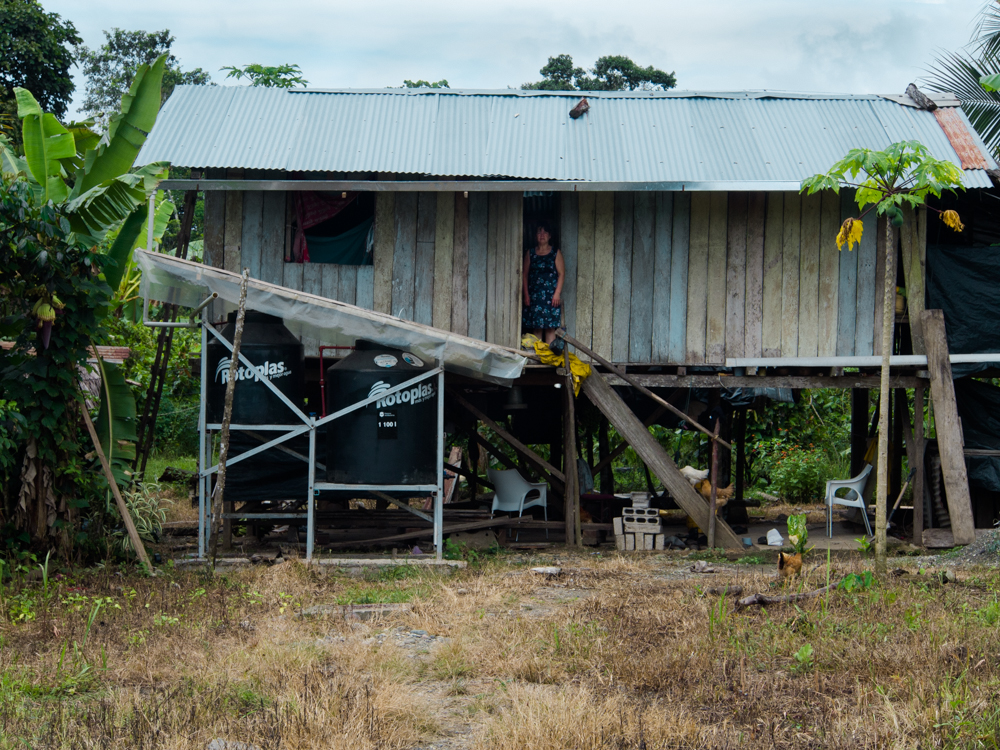
A colonist near Lago Agrio peers out from her home. The barrels in front are used to collect rainwater because the rivers and groundwater are too contaminated to use.
Oil activities have decimated the indigenous populations in the Amazon region. They’ve been pushed off their land, shot, and even told that the black crude oozing into their streams and rivers was full of vitamins and good for them. Entire ethnicities were wiped out. The few survivors, unable to live off the forest in the traditional way, became destitute peasant farmers, their shacks blending alongside those of colonists who are now settling on what used to be indigenous land. The children of the natives grow up, never learning the sustainable ways of their parents, and they too eventually become a part of this destructive process.
This process repeats itself anytime a new area was opened up to drilling. There was no reason to think the latest round of drilling would be any different.
I decided to go to the Amazon. There were rumblings of layoffs at my job, I had other work lined up — and I had a window of time in which I was free to plan this trip.
The idea was to gather photos and videos for a Kickstarter campaign. I would raise the funds for a film that would inform the world, and especially Americans about what I had learned. (Especially Americans because literally NO ONE I mentioned this to had any clue what was going on down there).
I came away somewhat disappointed, and I do not believe that the media I collected is anywhere near the quality that would motivate people on Kickstarter to trust me with their money. That’s not to say that the trip was useless — far from it. If nothing else, I came away with a clear idea of what it will really take to film a documentary in the Amazon in terms of costs, equipment needed, guides, etc.
I’ll be sharing some of the photos and video I made over the course of these next few posts.
I hope that this series can in some small way advance the cause of the Amazon and its people while I plan my next trip to Ecuador.
There is a lot I want to share with you, so please follow my blog so you can continue to read the rest of this series. Thanks!
 Richard Silvius